

Feedback is a powerful catalyst for success.
The following blog aims to set you up for success with regard to collecting and providing meaningful feedback. I will start off by sharing the importance of feedback. We will then cover the various types of feedback that I have encountered to date. After that, we’ll explore how to collect feedback and how to give effective feedback to others.
Ready to turn feedback into your stepping stone for growth? Let’s embark on this journey together by delving into the following:
The importance of feedback
I had the privilege of starting my career at a company that truly values feedback. Prior to the beginning of my career, I had encountered feedback in a mild way during my time as an undergraduate student (from group projects, etc.). However, I had never truly grappled with real-life, sometimes harsh, constructive feedback. Suddenly, I found myself expected to engage in self-reflection every couple of months. Not only did I need to provide feedback to myself, but I was also encouraged to seek input from colleagues. Initially, I didn’t always appreciate the value of regular self-reflection and feedback discussions. But looking back, I now recognize their importance.
Consider, for example, a line manager with various direct reports. Now, let’s assume that this line manager isn’t closely involved in your day-to-day activities e.g. he/she is working for a different client on a different project. The visibility of your work will undoubtedly be limited to your direct colleagues (and, if you’re fortunate, it might catch the attention of key stakeholders). Fast forward to your year-end review and put yourself in the shoes of your line manager. Without a record of regular feedback from your direct colleagues and/or key stakeholders, how will your line manager be able to engage in a constructive discussion with you? How will they determine if you are ready for a promotion? How will they assess whether you deserve to share in company profits and earn a bonus?
Some other benefits of gaining regular feedback include:
- Recognition: Every human being desires a sense of recognition. Proactively collecting feedback could very well lead to the recognition that you so desperately seek. In fact, in his book “Atomic Habits,” James Clear shares that we all “want to be acknowledged, recognized, and praised.”
- Self-development: Constructive feedback has the ability to highlight areas of development. By working on these areas, you will naturally grow over time.
The types of feedback
I like to distinguish between the following types of feedback:
Positive feedback
This includes any positive instance of feedback that you have received, e.g., you are always punctual, you always demonstrate professionalism, etc. It helps you recognize how your good behavior contributes to your environment and has the power to reinforce effective behavior.
Appreciative feedback
This includes appreciative and encouraging feedback and at least one suggestion to drive even better behaviour (i.e. high performance).
When providing somebody with appreciative feedback, we want to avoid telling the other person what to do; we leave the ownership with them and allow them to decide if they want to make use of your suggestion or not. We also try to avoid the word ‘but,’ as this word has a nasty way of making your feedback sound like critique and that you are otherwise instructing the other person to do something.
Note: This type of feedback is not designed for the year-end review, but it is more of an informal way to share feedback throughout the year with a colleague (when the opportunity arises).
Constructive feedback
This includes any constructive instance of feedback that you have received, e.g., you don’t always understand the ‘why’ behind a particular piece of work, and this impacts how you approach and eventually finish the said piece of work. This type of feedback is intended to change behavior and is key to improving performance and motivation.
For feedback to be constructive, it is important that the person on the receiving end recognizes the feedback:
- If they don’t, encourage them to validate the constructive feedback with others.
- If they do, drive the message home by also helping them identify some potential follow-up actions.
Critical feedback
This type of feedback is often provided when, despite previously providing constructive feedback, behaviour has not yet changed. As your career progresses, you’ll realize that the ability to provide critical feedback can either be:
- Career limiting: Failure to address poor performance may hinder overall team progress. Also keep in mind that as a leader, you are judged by what you do and don’t do.
- Career advancing: Constructive feedback helps individuals grow and contributes to team success.
Remember, not everyone is cut out for this role, but it’s essential to address performance issues for the benefit of the team.
Bad feedback
This includes any bad or poorly prepared feedback that you strongly disagree with upon careful and critical reflection. For instance, if someone accuses you of failing to think outside the box, despite clear examples of your innovative thinking. On the opposite end of the spectrum, you might encounter a colleague who consistently rates your work as a perfect 10/10 without providing any substantial explanation. After all, nobody is truly perfect, right? In such cases, consider asking the other person to offer constructive feedback to help you improve.
I would say that a combination of appreciative and constructive feedback should really be what you are after. If you respond to this correctly, it can greatly contribute to positive career and personal development. Remember, offense is taken, not given. This is a harsh reality that I had to accept early on in my career.
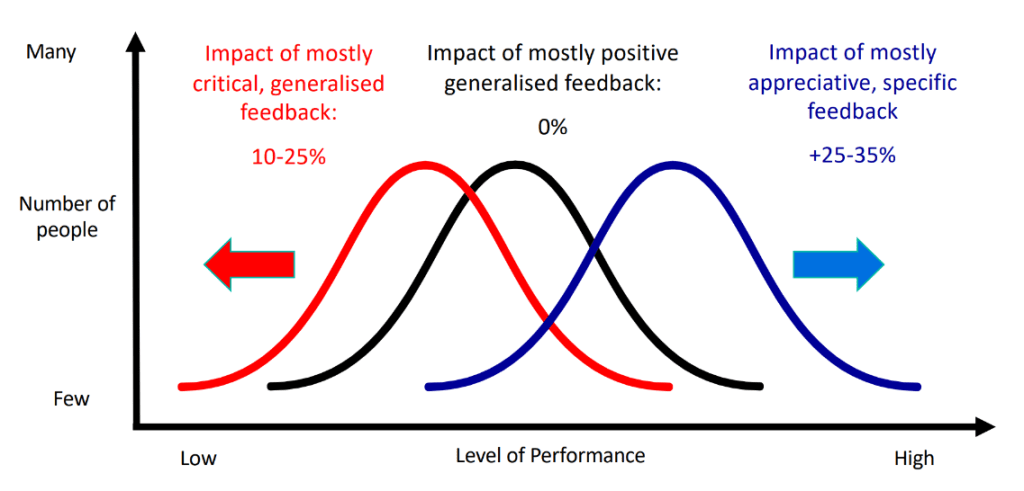
In a leadership training course, I once discovered that the impact of mostly appreciative, specific feedback can positively influence performance by 25-30%. On the other hand, mostly critical, generalized feedback can negatively influence performance by 10-25%.
How to collect feedback
As a young professional, it is crucial to avoid relying solely on feedback once a year (during the year-end review). Instead, cultivate relationships with trusted colleagues, mentors, or leaders who provide feedback consistently throughout the year. By doing so, the year-end review becomes a mere formality—a consolidation of the feedback you’ve received over time. To be perfectly clear, there should be no surprises when you approach your year-end review.
In his book Ego is the Enemy, Ryan Holiday emphasizes that mastering the art of receiving feedback, especially harsh and critical feedback, is an essential life skill. He argues that we should not only accept this feedback but actively seek it out, particularly when we are being reassured by our friends, family, or our own minds that we’re doing great.
Collecting feedback should be carefully planned and executed. If possible, implement a feedback framework that will provide you with regular feedback from identified stakeholders across the board—often referred to as 360-degree feedback. The exact frequency is at your discretion; however, I would caution against collecting feedback solely for the sake of it. An effective feedback framework is powerful and should almost always lead to individual growth.
When soliciting feedback from stakeholders and/or direct colleagues, ensure the process is as straightforward as possible for them to provide the necessary feedback that will foster your continuous growth. A method I often employ begins with creating a template that outlines your career objectives and/or goals (which should have been previously discussed with your manager). Adjacent to each objective and/or goal, I typically offer self-feedback by enumerating instances where I believe I’ve exhibited the requisite competencies. In a separate column, I reserve space for feedback from selected individuals. This template is then shared with my feedback providers, simplifying their task of providing constructive feedback. Consider this: I am essentially steering my audience through the process, but this should in no way limit their feedback. It’s important to communicate that you seek frank feedback, including potential areas for development. Below is an example of what I mean:

As a consultant, I have worked for many large organizations. Some of these organizations would focus more on general feedback, rather than on specific feedback linked to an employee’s career objectives and/or goals. For example, one organization was primarily interested in collecting the following data points for each employee:
- What are my strengths and my main development areas? Please provide examples.
- Please provide examples of how I exhibit my strengths and weaknesses.
- Please provide any other feedback you feel is relevant below.
These data points would then facilitate annual performance reviews. However, I would recommend opting for specific rather than general feedback.
At the end of the day, when it comes to selecting your feedback audience, you should strategically identify individuals who truly value your growth. Ideally, these would be people who are invested in seeing you succeed in your career.
Lastly, it may be useful to ask your feedback audience if you can review and discuss their feedback before recording it in a formal system (where your manager will have visibility). This will give you the opportunity to challenge any arguments you disagree with and align before it is documented in a system, preventing any surprises during the year-end review.
It is also important to be aware of the various cultures you are dealing with when collecting feedback, as this may impact the feedback and ratings you receive. For instance, a Dutch person might be very direct and is known for rarely giving a top rating (or ‘exceeds expectations’), whereas someone from India might be more inclined to say what you want to hear and give you a top rating, at the risk of not really highlighting areas for development. In her book Culture Map, Erin Meyer shares that ‘what is considered constructive in one culture may be viewed as destructive in another.’
How to provide feedback
Just as you will request feedback from others, they may also ask you to reciprocate. Based on my experience in providing feedback to team members, I highly recommend the following when you are expected to give feedback to your direct colleagues:
1. Develop a habit of giving regular, informal feedback, with a focus on strengths
2. If possible, don’t give direct criticism, but focus instead on strengths and suggestions for improvement
3. If things don’t improve, or you must give direct criticism:
- Do it soon, at an informal meeting if possible, and not in public -> “Praise in public, criticize in private” is a well-known mantra used by countless managers
- Acknowledge it’s a difficult (but crucial) conversation -> For great insights into having these types of conversations, I highly recommend the book ‘Crucial Conversations’ by Kerry Patterson
- Ensure the feedback is accurate, fair and clear (refer to the BEFCAS model below)
4. Plan formal routine one-on-one (1:1) review meetings which:
- Include a focus on strengths and suggestions for improvement
- Refer to improvements in response to previous suggestions for improvement
- Don’t bring new items of critical feedback into a routine review (see point #5)
5. When giving critical feedback in a formal setting, it is important to draw a distinction between new major issues and persistent issues—especially those where previous suggestions for improvement have not been taken seriously.
I would now like to provide you with some practical tools, including examples, for giving feedback to someone else.
Providing appreciative feedback
Let’s begin with a valuable technique for offering appreciative feedback. This type of feedback should always include two elements:
1. A personal, positive observation—something specific, for example:
- What I liked…
- What I appreciated…
- What stood out to me…
2. A suggestion for improvement—not a command or directive, for example:
To enhance this even further…
- I suggest that you…
- You might consider…
- Consider thinking about…
Here is a practical example from the world of MasterChef:
“The lamb was perfectly cooked, and the sauce was bursting with flavor. …to elevate the dish even more, I suggest cooking the carrots for one minute less.”
Providing critical feedback
A proven model, often useful for providing critical feedback, is the so-called BEFCAS model:
- Describe the specific observable Behavior:
- Use verbs to detail what they say or do (not what you imagine).
- Describe the practical Effects of their behavior:
- For example, on your work, the team, or the client (if appropriate).
- Express how you Feel, if appropriate:
- Accurately identify the emotion you feel.
- State the specific Change in behavior you desire from them:
- Use verbs to describe the observable change you seek.
- Listen Actively to their response.
- Conclude the discussion with a Statement of agreed action.
Here is a practical example of how I’ve applied the BEFCAS model when providing feedback to a colleague recently:
“Since the end of last year, I’ve observed that you’ve adopted a more passive role within our team. For instance, during important team meetings, your contributions are seldom heard, and when they are, it’s typically at the very end—a behavior also noticed by Richard.
The result is several moments of silence when active input and participation from the team are expected.
This leaves me feeling as though I’m the sole ‘captain’ navigating our ship. While I’m happy to make final decisions, I need substantial support from key team members like you.
I need your assistance in guiding our team. Previously, I’ve invited you to step into a leadership role as tech lead, and I’ll reiterate: I need you to step up and embrace the challenge, if you’re willing. This means actively contributing your professional opinion during discussions, without waiting for a prompt from me.”
After sharing this, I listened patiently to my colleague’s response and we wrapped up our discussion with a statement of agreed action.
Before providing any form of critical feedback, I strongly recommend beginning the conversation with this impactful one-liner:
“I am sharing this feedback because I hold very high standards, and I am confident that you can meet them.”
This statement powerfully affirms your belief in the other person’s abilities and your trust in their potential for improvement.
Over time, I’ve come to realise that making a habit of giving appreciative feedback can reduce the need to use BEFCAS. When a leader has a reputation for being generous in showing appreciation and offering development advice (suggestions for ‘even better’) it legitimizes their use of corrective feedback (BEFCAS). When a leader does use BEFCAS, the person receiving the critical feedback knows that the leader has a genuine concern and reason for providing it.
Another model that I have encountered in the past, also useful for critical feedback, is the so-called ‘four-step feedback loop’:
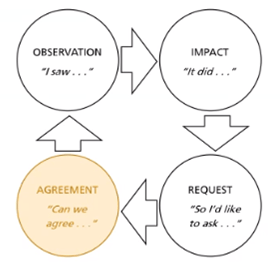
For example:
- I noticed that you have stopped sharing meeting notes after important gatherings
- It fosters transparency and ensures that everyone is on the same page
- I’d like to ask you to continue with this
- Can we agree that you do this? Similar to the BEFCAS model, we always want to end off with a statement of agreed action.
If you haven’t heard this before, you need to take charge of your own growth and personal development. Some people would even say that you need to take ownership of your career because nobody else will do it for you. In other words, you should be steering your career in the direction you deem fit and take regular checkpoints to assess whether you are still on the right path and experiencing continuous growth.
This can be facilitated by adopting a proactive mindset towards your career development:
- Always seek opportunities where you can stretch yourself and avoid comfort zones, especially early in your career.
- Review feedback with your line manager as it is received, making them aware of your impact within your ecosystem and that you take any areas for development very seriously.
Every young professional is best positioned to write his/her own career manuscript. What’s really important to note is that you cannot achieve your career goals—or anything, for that matter—by yourself. Focus on building a support network that can help and support you along the way.
Frank Shamrock, a pioneer in mixed martial arts and a multi-title champion, believes in a training system he calls “plus, minus, and equals.” Let’s break down how this system works:
- The Plus: This refers to training with someone who is more skilled than you. It could be your coach or sparring partners who can expose your weaknesses and help you learn and grow. These mini losses in practice are essential for improvement, as they occur in a controlled environment rather than during a public competition.
- The Minus: Here, you work with someone of lesser skill whom you can teach and help grow. Teaching others deepens your understanding of your own skills and provides an opportunity for mentorship.
- The Equal: Training with someone at your skill level allows you to challenge yourself. It’s a chance to test your abilities and receive feedback from a peer who understands the struggle.
By embracing this system, you continuously receive feedback about what you know and what you don’t know, ultimately helping you address blind spots and become better at what you do.
I hope this post gave you some valuable insights! If you found it helpful or have any thoughts to share, please leave a comment below and let me know. Your feedback helps me create better content for you. Don’t forget to hit that like button if you enjoyed reading!


 The Young Professional
Leave a reply to How to approach your annual review with confidence – The Young Professional Cancel reply