
7-10 mins
I’ve been thinking about this topic for a while now but haven’t had much time to reflect and put my thoughts down on paper. So, what changed? Well, things are about to get very busy at work, and I realized that this might be one of those moments where I’ll need to practice what I preach.
For those of you who don’t know, I embarked on a new corporate journey in March 2025 after a successful career in management consulting. In my current role, I lead a team of more than 11 people—and from Q3 onwards, I’ll be taking on a second team (> 13 people). While managing multiple teams isn’t new to me, adjusting to a new company has presented its challenges, and the first few weeks and months have, to say the least, been a bit chaotic.
Through past experiences, I’ve come to appreciate the power of a structured, systematic approach to work—especially during life’s busiest seasons. As James Clear notes in Atomic Habits, “We do not rise to the level of our goals, but fall to the level of our systems.” That’s why I’ve decided to write about this topic: to share insights that might help others—and, admittedly, myself—navigate the demands of an intense workload with greater clarity and effectiveness.
I’ll start with some wise words from Tim Ferris: “Spending a lot of time on something doesn’t make it important.” We often assume that if we’re busy, we must be doing valuable work—but that’s not always the case. Just because something takes up time doesn’t mean it truly matters.
That begs the question: What is truly important, and why is it crucial to make this distinction in our everyday lives?
Stephen Covey offers a great perspective in The 7 Habits of Highly Effective People: “We achieve inner peace when our schedule aligns with our values.” In other words, the things that matter most aren’t just urgent—they’re connected to what we care about.
At the end of the day, what’s important is what moves us forward. Whether in work or life, focusing on the right things—the ones that truly impact our goals—makes all the difference in the world.
But here’s the challenge: life is full of urgent demands that constantly fight for our immediate attention.
Dwight Eisenhower captured this dilemma perfectly when he said: “I have two kinds of problems: the urgent and the important. The urgent are not important, and the important are never urgent.”
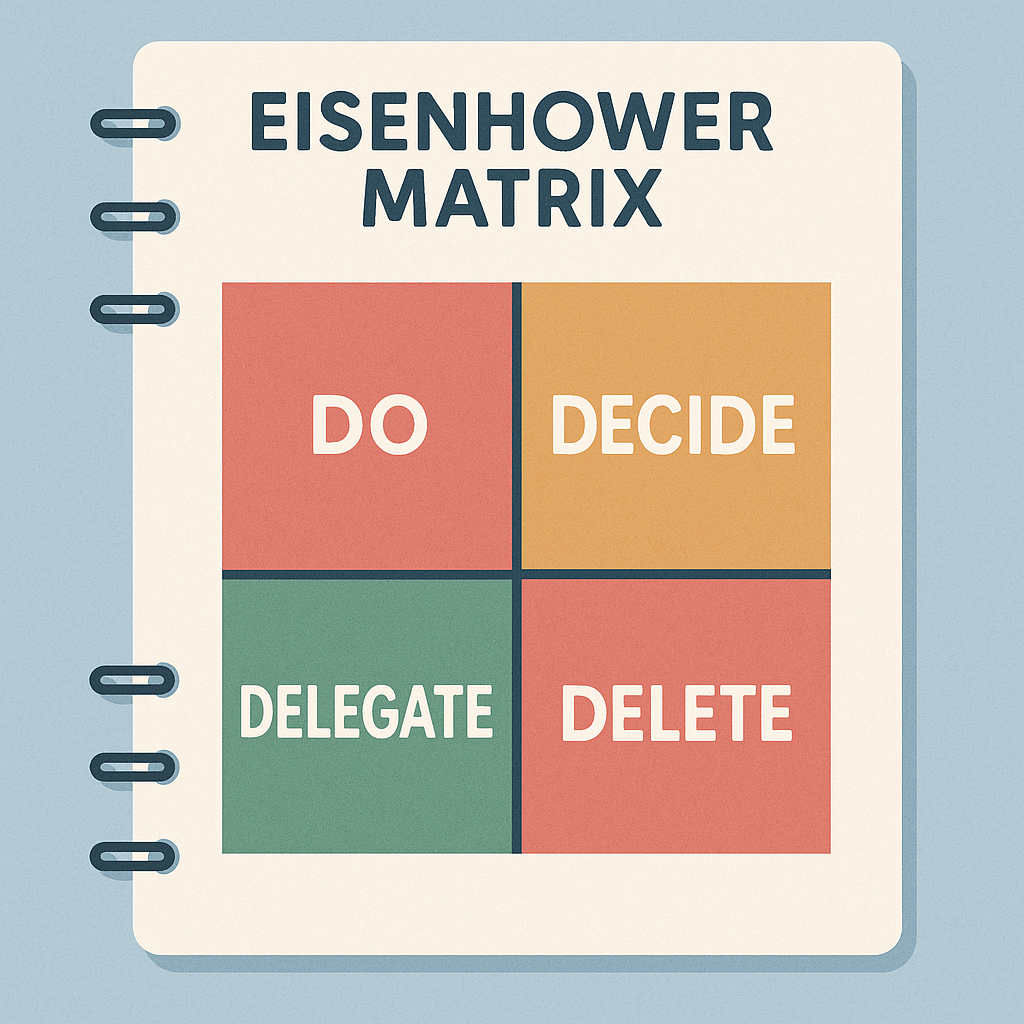
As a former U.S. president, he likely had one of the most demanding jobs on the planet. So, how did Eisenhower prioritize and efficiently manage his ever-growing list of tasks and responsibilities? Allow me to introduce you to the Eisenhower Matrix – a powerful decision-making tool that categorizes tasks into four quadrants based on urgency and importance:
- Important & Urgent
These tasks demand immediate attention—often carrying significant consequences if ignored. Think of pressing deadlines, crisis management, or high-stakes work that directly impacts you or your environment—each with the potential to set off a chain reaction.
- Important & Not Urgent
These tasks contribute to long-term success but don’t require immediate action. Strategic planning, personal development, and relationship-building often fall into this category—things that should be scheduled intentionally rather than rushed.
- Not Important & Urgent
These are the distractions that often feel important simply because they demand attention. Many emails, interruptions, or minor tasks fit here. While urgent, they don’t necessarily move the needle—making them ideal for delegation to free up time for more valuable work.
- Not Important & Not Urgent
These are the true time-wasters—things that neither contribute to your goals nor require immediate attention. Eliminating or minimizing these tasks is key to maintaining focus and efficiency.
If you don’t align your schedule with your most important work, you might very well become a slave to somebody else’s agenda. So, how do I make sure that never happens?
The first thing I do is take a step back and assess everything on my plate. I separate the important from the urgent—because, trust me, they are not the same. Once I have that clarity, I intentionally block out focus time in my calendar for the most important work.
And here’s the reality—you have to be selfish with your time. If you don’t protect it, other people will happily fill your schedule with their own priorities, and before you know it, you’ll have spent the entire day working on things that don’t truly matter to you.
I tried finding a solid example online that reflects this idea in practice, but this one below is the best I could come up with.
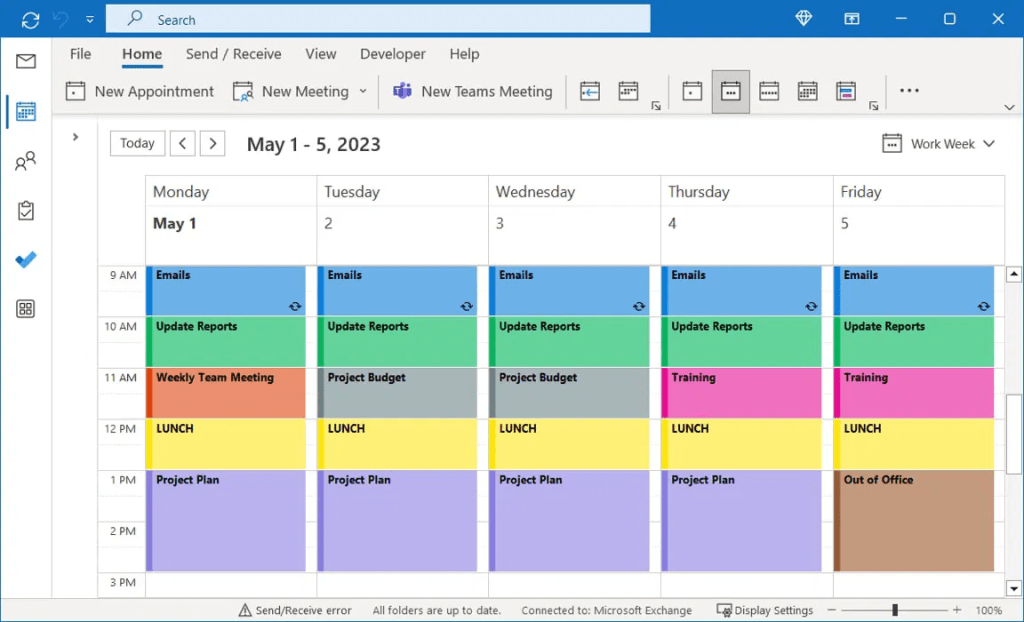
Source: https://www.maketecheasier.com/set-up-block-schedule-in-outlook-calendar/
At a glance, this might look like a Christmas tree, but this technique works like a charm for me. I literally schedule appointments with myself, blocking out dedicated “focus” slots for the most important work. The great thing is, your status will indicate that you’re busy, signaling to colleagues that it’s best not to disturb you—or that a delay in response is expected.
Another piece of advice? Build in some contingency. Let’s say I’ve identified an important task I need to tackle. When reserving time for it, I don’t always know exactly how long it’ll take. Instead of being overly optimistic and setting aside just 30 minutes (for example), I’ve learned to schedule 45-60 minutes instead. If I finish earlier—great! I’ll treat myself to a much-needed break. But if I need more time, I’ll be glad I gave myself that extra buffer.
For a while, I wasn’t building in contingency at all, leaving little room for error. That often led to residue—those lingering thoughts, tasks, or emotions that stick with you after something ends. In the case of back-to-back meetings, this meeting residue can create inefficiency, blur clarity, and even heighten stress if left unchecked. Recognizing this, I’ve found that creating space for flexibility isn’t just helpful—it’s been a game-changer in maintaining productivity and avoiding burnout.
The Eisenhower Matrix has become a lifesaver for me. I’ve fully integrated it into my weekly planning, and it genuinely helps me cut through the chaos of everyday life, keeping me focused on what truly matters.
To wrap things up, I want to share a powerful excerpt from Ego is the Enemy by Ryan Holiday:
“Eisenhower knew that urgent and important were not synonyms. His job was to set the priorities, to think big picture, and then trust the people beneath him to do the jobs they were hired for. Most of us are not the president, or even president of a company, but in moving up the ladder in life, the system and work habits that got us where we are won’t necessarily keep us there.“
That last part hits hard—because at the end of the day, success isn’t just about grinding harder; it’s about setting up systems that make it easier to perform at a high level, consistently. Reflecting on my own journey and where I’m headed, I realize that what worked up until now might not cut it in the big leagues. In fact, it’ll sink me if I don’t step up and organize better.
The Eisenhower Matrix is more than just a productivity tool—it’s a mindset shift. It’s about making conscious choices, protecting your priorities, and ensuring that your time is spent where it truly makes an impact.
So, as you look at your own workload, ask yourself: Are you focusing on what moves the needle, or are you constantly caught in a cycle of reacting to urgency? The answer might just change everything.
I hope this post gave you some valuable insights! If you found it helpful or have any thoughts to share, please leave a comment below and let me know. I’d also love to hear how you organize work during busy seasons—what strategies have helped you stay productive? Your feedback helps me create better content for you. And if you enjoyed reading, don’t forget to hit that like button! 🚀

 The Young Professional
Leave a reply to Extracting the most value from your meetings – The Young Professional Cancel reply